Organizational friction has many expressions. Decisions take longer than they should. Accountability becomes inconsistent. Collaboration across functions is difficult. Employees question leadership decisions. Priorities compete for attention. Change encounters resistance. Leaders spend increasing amounts of time resolving issues that should be addressed elsewhere in the organization.
These conditions are visible. The origins are not always as apparent.
This distinction matters because the language used to describe organizational friction often becomes the basis for the response. Slow decisions become an accountability issue. Uncertainty becomes a communication problem. Difficulty collaborating becomes evidence of silos. Persistent frustration becomes a culture problem. Once the issue has been named, attention naturally shifts toward solving it.
When the diagnosis is incomplete, an organization can invest in a well-designed intervention and still see little meaningful change—not because the intervention itself lacks value, but because it is being applied to a condition it was never designed to address. The challenge, then, is not simply recognizing that friction exists. It is understanding where the friction originates.
The Organization Is Experienced as a Whole
Organizations are often examined through distinct lenses. Strategy, structure, operations, leadership, talent, culture, and employee experience each provide useful ways of understanding how an enterprise functions. The organization itself, however, is not experienced in those distinctions.
A leader does not experience “structure” at 9:00 a.m. and “culture” at 10:30.
A decision that stalls may simultaneously involve unclear authority, competing priorities, relationships across functions, established leadership behaviors, insufficient information, and long-standing expectations about who ultimately makes the call. The leader experiences all of it as the organization.
This is what makes organizational diagnosis both important and difficult. The presenting issue often sits at the intersection of several conditions, even when the source of the friction is more concentrated in one. Organizational climate, culture, and enterprise capacity provide three particularly useful lenses through which to understand that distinction.
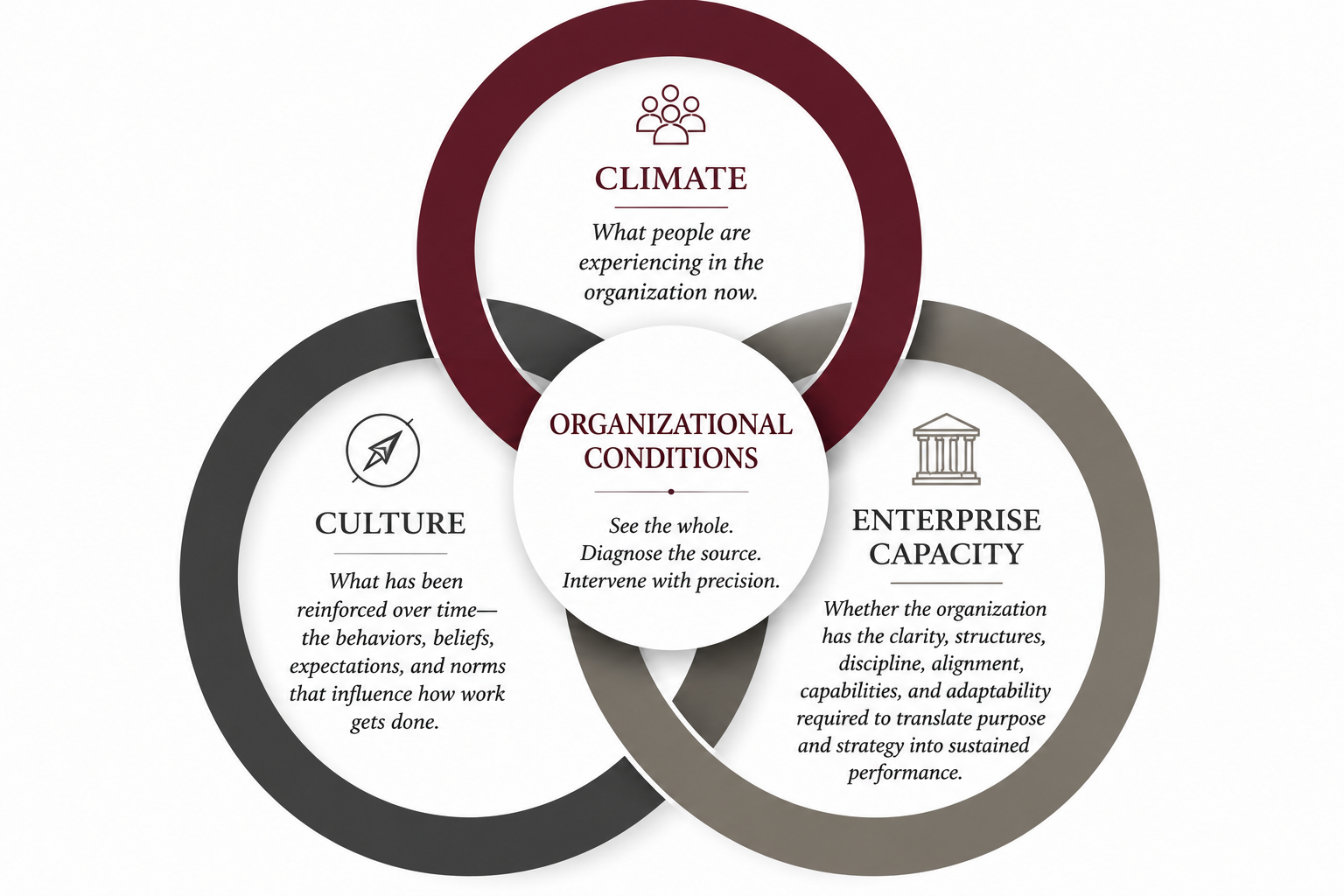
Organizational climate reflects what people are experiencing in the organization now. It can shift as leadership changes, uncertainty increases, priorities compete, performance pressures intensify, or the organization navigates significant change.
Culture reflects what has been reinforced over time—the behaviors, beliefs, expectations, and norms that influence how work gets done and how people respond to the situations they encounter.
Enterprise capacity considers whether the organization has the strategic clarity, structures, operating discipline, leadership alignment, capabilities, and adaptability required to translate its purpose and strategy into sustained performance.
Each reveals something different about the organization. Viewed independently, however, each can lead toward a partial explanation. Their greater value comes from considering all three before determining where intervention is required.
The featured graphic illustrates this relationship: climate, culture, and enterprise capacity provide distinct but interconnected views of organizational conditions. Together, they create the context for understanding where organizational friction may originate.
The Same Friction Can Have Different Origins
Consider slow decision-making. Leadership may see decisions repeatedly moving upward and conclude that managers need to take greater ownership. The organization strengthens expectations for accountability, invests in leadership development, and encourages managers to become more decisive. Those actions make sense if the primary condition is behavioral.
Suppose, however, that managers are operating within a structure where decision rights are unclear, significant decisions routinely require senior approval, or decisions made at lower levels are frequently revisited. Managers are now being encouraged to exercise greater ownership while the operating environment continues to signal that authority sits elsewhere. The resulting friction is not simply a failure of accountability; it reflects a gap in enterprise capacity. A stronger accountability intervention does not resolve that gap and may actually increase frustration as managers are held responsible for exercising authority the organization has not fully enabled them to use.
The same principle applies to organizational uncertainty. Employees may express declining confidence, frustration, or a desire for more communication during a leadership transition, restructuring, merger, or significant strategic shift. Those signals can quickly generate concern about culture. Yet the primary condition may be climate. People are trying to make sense of a changed environment and may need greater clarity about direction, consistency in leadership messages, visible leadership presence, and enough stability to understand what the change means for their work. A culture initiative may be thoughtfully designed and still miss what the organization needs most in that moment.
The opposite can also occur. Leadership may repeatedly treat an entrenched behavioral pattern as a temporary climate issue by providing more communication, creating opportunities for listening, and reassuring employees that expectations are changing. If the organization has consistently rewarded, tolerated, or reinforced the behavior over time, however, the condition may have become cultural. Communication can clarify the desired behavior, but it cannot, by itself, change what the organization continues to reinforce.
The visible friction may look similar across these examples, but the appropriate intervention changes because the underlying diagnosis changes.
When the Response Creates More Friction
The consequences of organizational misdiagnosis become more significant when the intervention itself enters the system. An organizational response is not neutral. It communicates something about how leadership understands the issue, where responsibility is believed to reside, and what people are expected to do differently.
Managers may be told to take ownership while authority remains centralized. Employees may be encouraged to collaborate while goals, resources, and incentives continue to reinforce functional performance. Leaders may be asked to communicate more frequently when the underlying issue is that strategic priorities have not been resolved. Teams may receive change-management support when what they need is sufficient staffing, clearer processes, or different capabilities to execute the change. Employees may participate in listening sessions while behaviors they have identified as problematic continue to be rewarded or tolerated.
Each intervention may be entirely reasonable in another organizational context. The friction emerges from the mismatch between the condition and the response.
Over time, that mismatch can create consequences beyond the original issue. Leaders become frustrated that people are not responding. Employees become skeptical of new initiatives. Managers expend energy trying to reconcile competing expectations. Organizational activity increases without a corresponding improvement in performance.
Perhaps most consequentially, the lack of movement can then be interpreted as further evidence of the original diagnosis. Managers still are not accountable. Employees are resistant to change. Teams will not collaborate. The culture is difficult. What began as an incomplete diagnosis can become a reinforcing cycle in which the organization’s response contributes to the very friction it is attempting to resolve.
The Intersection Provides Context; the Diagnosis Provides Direction
Looking at climate, culture, and enterprise capacity collectively does not mean every organizational issue requires intervention across all three. Doing so would simply replace one form of overdiagnosis with another.
The value of the collective view is the context it provides. A climate condition may be influenced by culture. A capacity constraint may be creating an experience that affects climate. A cultural norm may be limiting the organization’s ability to develop the capacity required by its strategy. Those relationships matter because organizations operate as systems. Intervention, however, still requires precision.
If decision-making friction is primarily being created by unclear authority, the organization may need to address decision rights and operating structure. Leadership behavior and culture may influence whether the change takes hold, but the intervention begins with capacity.
If employees are experiencing uncertainty following significant organizational change, the immediate response may appropriately focus on climate through greater clarity, leadership presence, communication, and stabilization, even while leadership remains attentive to longer-term cultural implications.
If a behavior has been consistently reinforced over time and has become part of how the organization operates, changing a process or increasing communication may be insufficient. Leadership may need to address what is rewarded, tolerated, modeled, and held accountable. In that case, the intervention moves into culture.
There will also be situations in which the diagnosis reveals a genuine intersection requiring coordinated movement. The objective is not to force an issue into a category or to address everything simultaneously. It is to understand the organization well enough to determine where movement needs to begin and what other conditions may influence whether that movement can be sustained.
Strategy Changes the Diagnostic Context
The distinction among climate, culture, and enterprise capacity becomes even more consequential when the organization itself is changing. Growth, new technology, increased complexity, leadership transitions, market shifts, or a new strategic direction can alter what the enterprise must be capable of doing consistently.
This matters diagnostically because an established way of operating may not have been problematic in the context in which it developed. Informal coordination may have supported speed in a smaller organization. Consensus may have strengthened commitment when broad participation was essential. Senior leaders remaining close to operations may have enabled responsiveness during an earlier stage of growth. These practices may have contributed meaningfully to the organization’s success.
The friction emerges when the requirements of the enterprise change and established ways of operating no longer fully support them. Informal coordination may become inconsistent at scale. Consensus may create tension when the strategy requires greater decision speed. Senior leadership involvement may constrain the distributed authority now necessary to manage increased complexity.
These conditions can easily be interpreted as cultural or leadership problems when the more fundamental issue is a changing relationship between strategy and enterprise capacity. The question is therefore not simply what is no longer working, but what must the organization be capable of doing for its strategy to succeed, and where is the current organization creating friction against that requirement?
That distinction keeps diagnosis from becoming an assessment of what is “wrong” with the organization. Sometimes the friction is evidence that the organization has reached the limits of a capability, practice, or way of operating that served it well in an earlier context.
Understanding that difference matters. The intervention required to correct a dysfunctional condition may be very different from the one required to evolve an organization whose strategic requirements have changed.
From Organizational Friction to Organizational Precision
Organizational friction should get our attention because it signals that something within the system deserves to be understood. But friction is evidence; it is not necessarily the diagnosis.
Moving beneath what is immediately visible requires leadership to consider the organizational conditions surrounding the issue. What are people experiencing now? What has been reinforced over time? What is the organization structurally and operationally capable of doing? Where are those conditions aligned, and where are they in tension? Most importantly, where does the source of the friction appear to sit?
Viewed this way, climate, culture, and enterprise capacity are not competing explanations. Together, they provide a more complete view of the organization from which a more precise response can emerge. Sometimes that response will focus primarily on climate. Sometimes it will require cultural work. Sometimes the answer will sit within enterprise capacity. In other situations, movement across more than one condition will be necessary.
The discipline is resisting the urge to begin with the intervention before understanding the condition. When the diagnosis is wrong, organizations do more than invest in an ineffective solution. They can create new expectations without changing the conditions required to meet them, adding another layer of friction to the system.
The cost of getting the diagnosis wrong is not simply an ineffective solution. It is the possibility of creating more of the very friction leadership is trying to resolve.
Climate, culture, and enterprise capacity provide a way to see the organization more fully before deciding where to act. Their intersection provides context; the diagnosis provides direction.
The right solution is not simply the one that addresses what leadership can see. It is the one that addresses what is creating the friction.
So before we call it a culture problem, the more consequential question may be:
What organizational condition is creating the friction, and what does that tell us about where the response belongs?
About Daphne B. Latimore
Daphne B. Latimore is an organizational strategist, executive thought partner, and Managing Partner of DB Latimore Professional Services Group. Drawing on more than three decades of human capital and organizational leadership experience, she works with executives and leadership teams to examine the conditions shaping organizational performance and strengthen the alignment among strategy, leadership, people, and operations.
Her work spans enterprise capacity, culture and organizational alignment, executive thought partnership, leadership development, and strategic facilitation. Through DB Latimore, Daphne helps leaders move beyond the presenting issue to understand what is happening within the organization, what the enterprise requires next, and where intentional action can strengthen performance.
Enabling Purpose. Empowering Performance.™