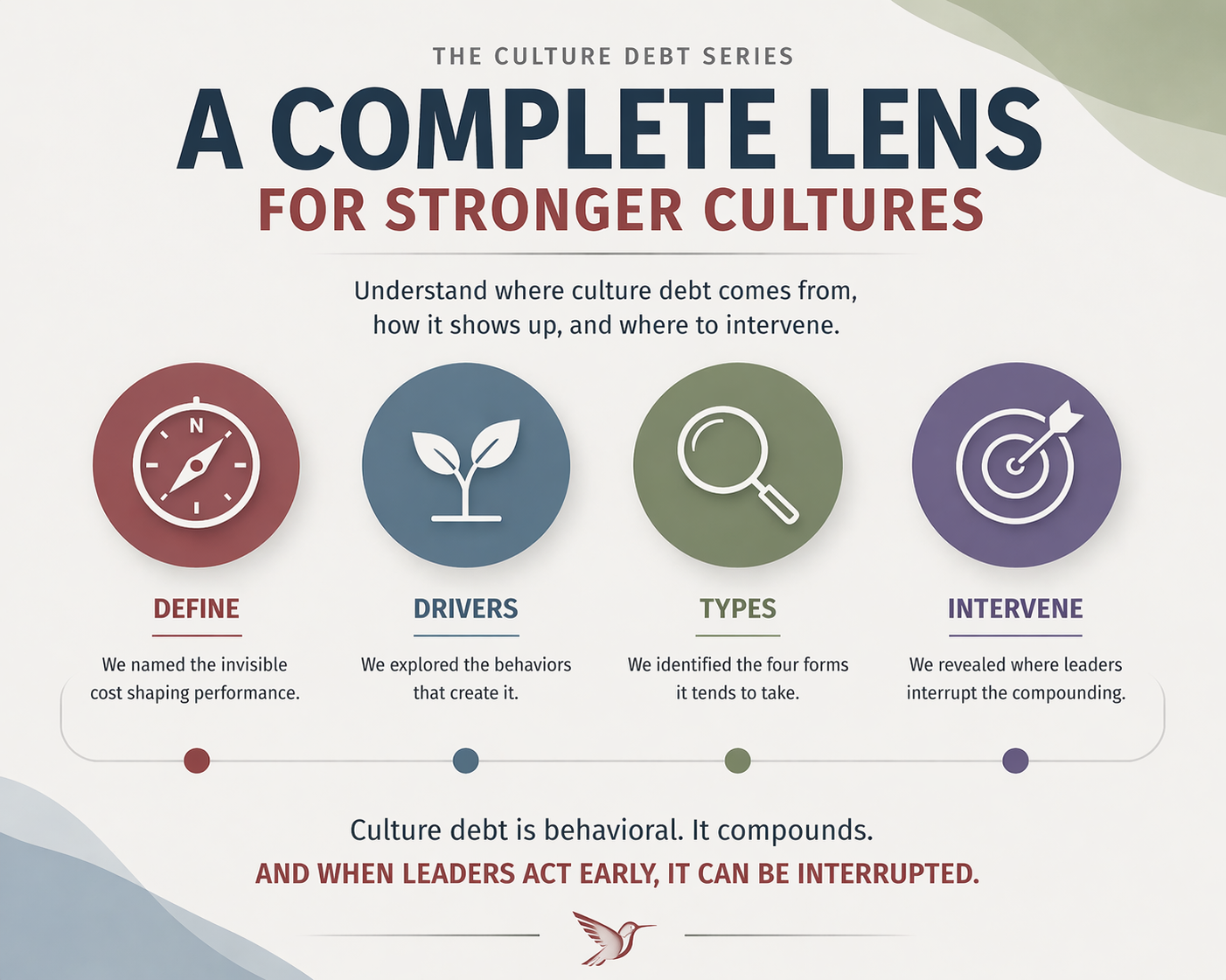
Across this series, we have defined culture debt, examined the behavioral drivers that create it, and outlined the forms it takes inside organizations.
The natural next question is not simply what it is, but:
Why does it grow—and what does it take to interrupt it?
Culture debt does not remain static. It compounds.
Not suddenly, but incrementally.
A decision revisited becomes a pattern.
A pattern repeated becomes a norm.
A norm reinforced becomes the culture people experience every day.
Over time, what once felt like a small inconsistency begins to shape how the organization operates—often in ways that are difficult to reverse.
The compounding effect is what makes culture debt so consequential.
It spreads quietly across:
- how decisions are made
- how information is interpreted
- how accountability is applied
- how tension is managed
What begins in one area rarely stays contained. It moves through the system, reinforcing itself as it goes.
By the time performance metrics reflect concern, the underlying behaviors have already been normalized. For this reason, culture work cannot begin at the level of outcomes.
It must begin where the compounding starts. Behavior.
<br>
Where Leaders Interrupt the Pattern
Interrupting culture debt does not require broad transformation efforts.
It requires precision.
Leaders who effectively interrupt culture debt focus their attention on the points where behavior becomes pattern—and where pattern becomes norm.
In decision-making, interruption begins with clarity.
Clear ownership.
Clear finality.
Clear reinforcement.
Not more discussion—but more consistency in how decisions are made and held.
In information flow, interruption begins with access and context.
Ensuring that what is known is shared in a way that supports alignment, rather than leaving teams to construct their own interpretations.
Not more communication—but more intentional communication.
In accountability, interruption begins with consistency.
Expectations that are explicit, reinforced, and applied regardless of level or circumstance.
Not more oversight—but more predictability.
In conflict, interruption begins with willingness.
A willingness to surface tension early, to engage directly, and to treat disagreement as part of alignment rather than a threat to it.
Not more confrontation—but more clarity.
These are not large shifts. But they are precise ones.
And precision is what interrupts compounding.
The Leadership Responsibility
Culture is often described as something that evolves over time, and it does. Hiwever, it is also shaped—continuously—by what leaders allow, reinforce, and revisit.
Culture debt accumulates when behaviors go unexamined. It compounds when patterns go unchallenged, and it becomes embedded when norms go unaddressed.
The responsibility of leadership is not to control culture. It is to bring clarity to the behaviors that shape it.
Because when behavior is clear, patterns shift.
When patterns shift, norms change.
And when norms change, culture follows.
Closing the Loop
Culture debt is not abstract. It is not inevitable. It is not irreversible.
It is behavioral.
It is observable.
And it is interruptible.
What this series has made clear is that culture is not formed by intention alone. It is formed by the consistency of behavior over time.
In practice, this work begins with understanding which behavioral patterns are most active within the organization. It requires more than observation—it requires a structured way to assess how decisions are made, how information flows, how accountability is reinforced, and how conflict is handled across the system.
When these patterns are examined intentionally, leaders gain a clearer view of the forces shaping their culture—and where to intervene with precision.
If your organization is experiencing friction that feels structural rather than situational, this may be the moment to examine the behaviors shaping how work gets done.