
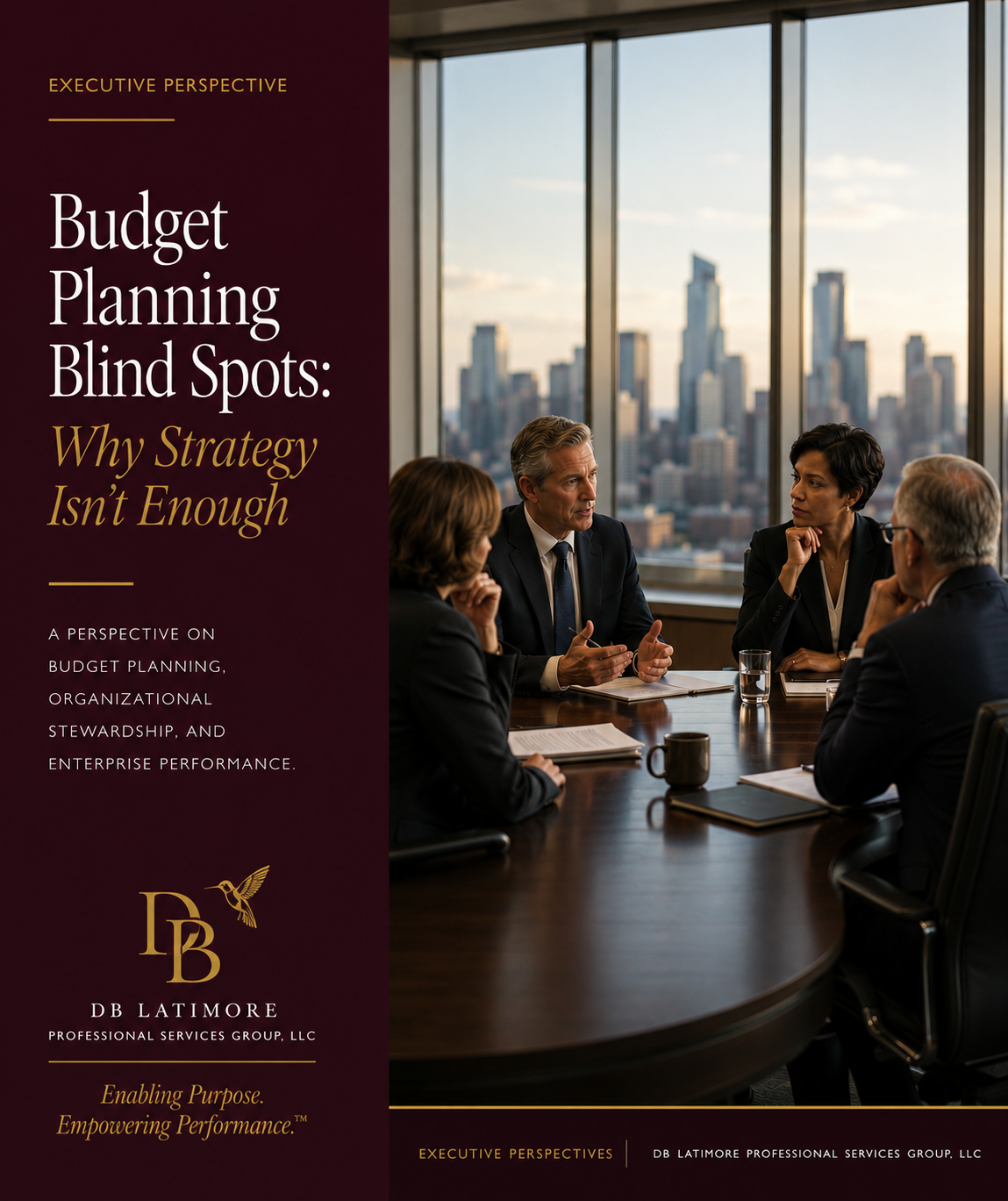
For many organizations, budget planning signals the beginning of a new chapter. Executive teams come together to establish priorities, evaluate financial projections, consider strategic investments, and determine where the organization will focus its attention in the year ahead. These discussions represent one of the most significant leadership responsibilities of the year because they influence not only the allocation of financial resources, but also the direction of the organization itself.
While budgets are often viewed primarily through a financial lens, I have come to appreciate that they represent something much broader. Every investment decision reflects a strategic choice, and every strategic choice creates expectations that extend well beyond the financial commitment. New initiatives require leadership attention. Growth creates additional operational demands. Strategic priorities influence governance, decision-making, communication, and, ultimately, the organization’s ability to execute. In that sense, a budget becomes much more than a financial plan; it becomes an expression of organizational intent.
Throughout my work with executive teams, I have observed that significant attention is understandably devoted to evaluating financial assumptions, validating investment decisions, and aligning resources with strategic priorities. Those conversations are essential to responsible stewardship. At the same time, I have found it valuable to consider another dimension of the planning process—what approved investments will require of the enterprise responsible for delivering them.
Every strategic investment carries both a financial commitment and an organizational commitment. The financial commitment is reflected in the budget. The organizational commitment is reflected in the expectations placed upon leadership, governance, operational systems, and the people responsible for execution. While financial commitments are carefully examined before approval, organizational commitments often become most visible during implementation.
This distinction becomes increasingly important as organizations navigate greater complexity. Rarely do organizations struggle because they lack worthwhile initiatives. More often, they are managing the cumulative demands created by many worthwhile initiatives pursued simultaneously. Individually, each investment may be appropriate and well aligned with the organization’s mission. Collectively, those same investments can place increasing demands on leadership capacity, decision-making, organizational systems, and operational coordination. The challenge is seldom the quality of the individual decisions. Rather, it is understanding the collective demands those decisions place upon the enterprise.
This perspective is also reflected in broader organizational research. The Project Management Institute’s 2025 research on strategy execution highlights that the disconnect between strategic planning and execution remains one of the most significant barriers to organizational transformation. Similarly, McKinsey & Company has emphasized that successful organizational transformation depends not only on strategy, but also on leadership alignment, organizational design, and operating models that enable effective execution.
For me, these findings reinforce an observation that has emerged repeatedly throughout my work with executive teams. Successful execution depends upon more than identifying the right strategic priorities. It also depends upon understanding what those priorities will require of the organization responsible for delivering them.
Viewed from this perspective, budget planning becomes more than an exercise in financial stewardship. It also becomes an opportunity for organizational stewardship. Considering the organizational implications of strategic investments while priorities are still being shaped broadens the executive conversation. It does not diminish ambition or slow decision-making. Rather, it creates an opportunity to consider how strategy, leadership, governance, and organizational performance intersect before commitments are finalized.
Every budget reflects a series of financial decisions. It also creates a series of organizational commitments. The financial commitments are visible in the numbers. The organizational commitments emerge through the enterprise itself—through leadership, governance, decision-making, operating practices, and the collective ability of people to translate strategic intent into meaningful results. Considering both dimensions together provides a more complete view of what successful execution will require.
Within my work, I describe these organizational conditions through the lens of Enterprise Capacity—the organizational conditions that enable strategy to become sustainable performance. Whether organizations use that language or another is less important than the conversation it encourages. As executive teams prepare for the year ahead, budget planning presents an opportunity to consider not only what the organization intends to fund, but also what those investments will require of the enterprise responsible for delivering them.
Continue the Conversation
Budget planning creates a unique opportunity for executive teams to consider not only what they intend to accomplish, but also what successful execution will require of the enterprise.
Many of the observations shared in this Executive Perspective have been reinforced through the Enterprise Capacity Executive Discovery™—an executive advisory process designed to help leadership teams examine the organizational conditions that influence their ability to execute strategic priorities before significant organizational commitments are made.
If these ideas resonate with the conversations taking place within your leadership team, the next step is not another article. It is a conversation.
I welcome the opportunity to explore how the Enterprise Capacity Executive Discovery™ can support your organization’s planning and decision-making as you prepare for the year ahead.
Budgets determine where organizations invest their financial resources. Enterprise Capacity determines whether those investments achieve their intended purpose.
Sources
- Project Management Institute. New PMI Research Reveals Strategy Execution Gap Is Undermining Transformation. 2025.
- McKinsey & Company. A New Operating Model for a New World. 2025.