As I continue working with leadership teams on cultural alignment, defining culture behaviors, and helping businesses navigate what I increasingly describe as behavioral coherence, one pattern continues surfacing across industries:
The culture experience no longer remains contained inside the corporate walls.
That distinction matters.
For years, organizational culture functioned primarily as an internal conversation. Leadership teams focused on values, employee engagement, mission alignment, leadership development, and workplace experience largely through an internal lens. Culture lived inside leadership retreats, employee surveys, onboarding presentations, values campaigns, and internal messaging strategies.
Today, culture operates differently.
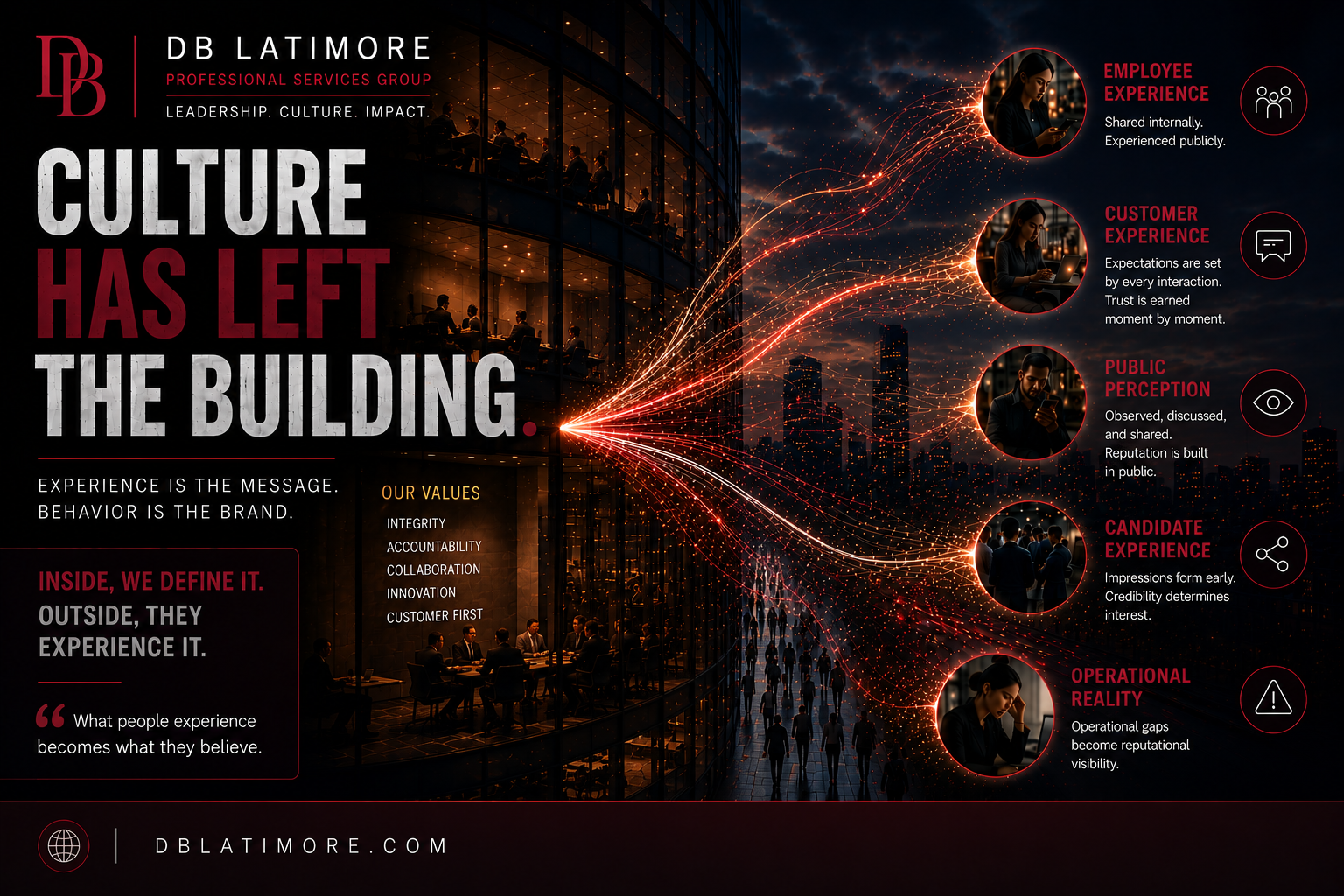
Culture leaves the building through the cumulative experience people have with the business every single day.
Mission statements, employer branding campaigns, and leadership messaging serve as the vehicles.
Experience becomes the exclamation.
Organizations still define culture internally through values, vision statements, and carefully constructed narratives. The outside world experiences culture behaviorally. Responsiveness. Consistency. Accountability. Communication. Operational discipline. The way people behave when pressure increases.
That reality sits at the center of what I describe as behavioral coherence.
Behavioral coherence emerges when leadership communication, operational behavior, decision-making, accountability, employee experience, and customer experience consistently reinforce one another across the business.
I have sat inside culture design sessions with leadership teams working to define organizational values and cultural expectations, only to discover that members of the same leadership team often hold materially different interpretations of what those values actually mean operationally.
The conversation may begin with agreement around words like accountability, collaboration, innovation, or customer centricity. The divergence emerges when leadership teams begin describing how those values should appear in decision-making, communication, performance expectations, conflict navigation, operational priorities, and customer experience.
Alignment around language does not always translate into alignment around behavior.
In many ways, culture begins leaving the building long before leadership teams realize behavioral fragmentation already exists internally.
Many businesses struggle not because they lack values, but because the lived operational experience contradicts the cultural narrative leadership believes people are experiencing.
Customers encounter one company at the point of sale and another when resolution becomes necessary. Employees hear collaboration emphasized publicly while navigating internal competition operationally. Accountability becomes embedded in leadership messaging while behavioral exceptions continue unchecked across layers of the enterprise.
Over time, culture stops being interpreted primarily through messaging.
It becomes interpreted through accumulated experience.
That shift fundamentally altered organizational visibility.
Employees, customers, candidates, investors, and communities no longer experience the business from separate vantage points. Internal friction rarely remains internal long enough for leadership teams to privately absorb, manage, or reframe the impact. Executive messaging now exists alongside operational behavior, customer experience, employee interpretation, and public observation simultaneously.
The separation between internal culture and external experience collapsed.
Behavior became observable.
Businesses now operate inside a continuous visibility environment where operational behavior is interpreted in real time. Customers document experiences instantly. Employees openly share workplace realities. Candidates evaluate leadership credibility long before applying. Public statements exist alongside customer experience, employee interpretation, and operational response.
Evaluation no longer occurs solely through products, services, or quarterly performance.
Evaluation increasingly occurs through experience — the delayed response to a customer concern, the frontline employee attempting to navigate unclear direction in real time, the leader publicly communicating accountability while operational inconsistency remains tolerated internally, the candidate drawn in by a polished employer brand only to encounter fragmentation immediately after onboarding, the public apology that reveals an operational fracture employees have quietly managed around for months.
These moments accumulate.
Collectively, they shape how trust, credibility, and organizational integrity are interpreted externally.
A new social contract has emerged between businesses and the people experiencing them.
Products, services, and financial performance still matter. Behavioral consistency now shapes trust, credibility, and reputation with equal force.
People pay attention to how leadership communicates under pressure. How accountability appears operationally rather than rhetorically. Whether values remain visible when execution becomes difficult. Whether decision-making remains consistent across levels of leadership. Whether the customer experience aligns with the promises attached to the brand.
The shift explains why leadership language has changed so noticeably in recent years. Alignment. Accountability. Simplification. Operational discipline. Consistency. Execution.
The language reflects leadership teams attempting to stabilize coherence inside increasingly observable systems.
Operational inconsistency no longer remains contained long enough for quiet correction.
Operational friction becomes reputational friction.
Reputational friction compounds quickly.
Values Communicate Aspiration. Behaviors Create Experience.
Many leadership teams continue approaching culture as an aspirational construct while employees, customers, and candidates evaluate it as lived experience.
The distinction carries significant consequences.
Most companies possess clearly articulated values. The challenge rarely involves the absence of values. The challenge emerges when leadership mistakes values for culture itself rather than recognizing that behaviors create the actual culture experience.
Values communicate aspiration.
Behaviors establish credibility.
Credibility forms publicly.
A company may communicate agility while employees experience bureaucracy. It may communicate customer centricity while customers experience inconsistency. It may communicate accountability while leaders reinforce ambiguity, exceptions, or uneven standards operationally.
People eventually trust behavior more than messaging.
Lived experience consistently outweighs stated intention.
Stakeholders do not experience companies departmentally.
They experience them cumulatively.
The business arrives as one interconnected system.
Contradictory behaviors inside that system create fragmentation externally long before leadership formally diagnoses the problem internally.
The pattern appears most visibly inside operationally intensive industries where customer experience unfolds in real time — retail, hospitality, healthcare, restaurants, travel, financial services, and other high-interaction environments where operational behavior becomes inseparable from brand experience.
Presentations, values campaigns, and internal messaging hold limited power once operational behavior becomes the brand experience itself.
Visible operational friction frequently reflects deeper fragmentation surrounding expectations, accountability, decision-making, and behavioral reinforcement.
When Operational Inconsistency Becomes Public
Operational inconsistency rarely announces itself dramatically in the beginning.
It surfaces quietly.
A delayed customer response. Conflicting direction between leaders. A frontline employee improvising around a broken process to protect the customer experience. A manager interpreting accountability differently than another department. A high-performing employee compensating for operational gaps leadership has not fully recognized yet.
Initially, the business absorbs the friction.
Customers remain loyal despite inconsistency. Employees adapt around broken processes. Strong performers quietly stabilize areas of operational weakness. Middle managers work to reconcile competing priorities across departments. Leadership teams continue driving strategy while assuming the operational strain remains manageable.
Over time, however, the inconsistency compounds.
What once appeared to be isolated operational issues begin revealing a deeper pattern of fragmentation surrounding expectations, accountability, communication, decision-making, and behavioral reinforcement.
The customer experiences one standard in one location and another somewhere else. Employees receive different interpretations of priorities depending on the leader, department, or business unit involved. Decision-making slows as operational clarity weakens. Accountability becomes unevenly experienced across the enterprise.
The business gradually begins operating from multiple interpretations of what success actually requires.
That fragmentation rarely remains internal for long.
Frontline employees experience the inconsistency before executives formally diagnose it. Customers recognize the friction before the trend lines fully appear in reporting dashboards. Candidates sense misalignment during recruitment conversations. Public credibility begins eroding long before leadership teams fully understand the operational implications underneath the surface.
External experience becomes the diagnostic signal.
That reality fundamentally changes how culture must be understood.
Culture no longer functions as the softer side of business operations. Culture functions as behavioral infrastructure — the reinforcement system shaping how accountability is experienced, how decisions move through the business, how conflict is navigated, how priorities are interpreted, and whether execution can scale consistently across the enterprise.
Operational inconsistency often represents behavioral inconsistency repeated systematically throughout the business.
The pattern connects directly to culture debt.
Culture debt accumulates quietly through repeated postponement of leadership alignment, behavioral clarity, difficult conversations, decision transparency, role accountability, and operational consistency.
The impact remains manageable for a period of time.
High performers compensate. Leaders overextend. Employees adapt around broken systems. Customers tolerate friction longer than leadership expects.
Eventually, the strain becomes externally visible.
Execution slows. Trust erodes. Consistency weakens. Customer frustration increases. Employee disengagement becomes more visible. Leadership attention shifts toward managing operational drag rather than sustaining strategic momentum.
At that point, the culture conversation no longer remains internal.
The business itself begins communicating the culture externally through experience.
Public experience forms faster than formal organizational resolution.
The New Leadership Imperative
One of the defining leadership realities of this era emerges quietly inside the gap between what businesses communicate and what people consistently experience.
The challenge no longer centers solely on defining values, crafting culture statements, or communicating vision clearly enough to inspire the workforce.
The challenge centers on behavioral coherence.
Leadership teams now operate inside systems where operational inconsistency becomes externally visible faster than many businesses can internally stabilize alignment. Customers experience the fracture. Employees compensate around it. Candidates recognize it during recruitment. Public credibility begins eroding long before dashboards formally diagnose the problem.
The pattern appears repeatedly across industries.
A leadership team communicates accountability while operational exceptions continue unchecked. Customer centricity becomes a stated priority while frontline employees lack the authority, clarity, or support required to resolve problems consistently. Agility becomes part of the organizational narrative while decision-making remains slow, fragmented, and heavily layered.
Over time, the contradiction becomes culturally visible. Not because stakeholders suddenly gained access to the internal culture strategy, but because they experienced the business itself. They experienced the delayed response. The inconsistent decision. The leader communicating one expectation while operational behavior reinforced another. The customer frustration frontline employees had already learned to navigate around quietly.
The experience tells the story long before the organization formally acknowledges it.
That reality fundamentally changes the role of leadership.
Leadership communication no longer functions solely as inspiration. It functions as organizational signaling. Employees interpret it. Customers compare it against experience. Candidates evaluate whether the message aligns with the behavior they encounter entering the business.
Execution changes as well.
Execution no longer reflects operational competence alone. It becomes cultural evidence — visible proof of whether alignment, accountability, communication, and leadership behavior are actually operating coherently throughout the business.
The businesses most likely to sustain credibility over time may not be the companies with the loudest vision, the strongest branding, or the most ambitious transformation initiatives.
More likely, they will be the businesses capable of creating consistency between leadership behavior, operational reinforcement, employee experience, and customer reality.
Businesses increasingly require more than culture messaging.
Leadership alignment. Behavioral clarity. Operational consistency. Reinforcement systems capable of sustaining coherent behavior at scale.
The business itself ultimately communicates the culture.
Not through aspiration alone.
Through experience.