In the first article of this series, we defined culture debt as the accumulated weight of unresolved behaviors—the patterns organizations learn to work around rather than address. It’s the quiet drag inside a system that leaders often feel long before they can name it.
The natural next question becomes:
Where does culture debt actually begin?
It doesn’t start in values statements.
It doesn’t begin in engagement surveys.
And it does not originate in strategy decks.
Culture debt begins in behavior.
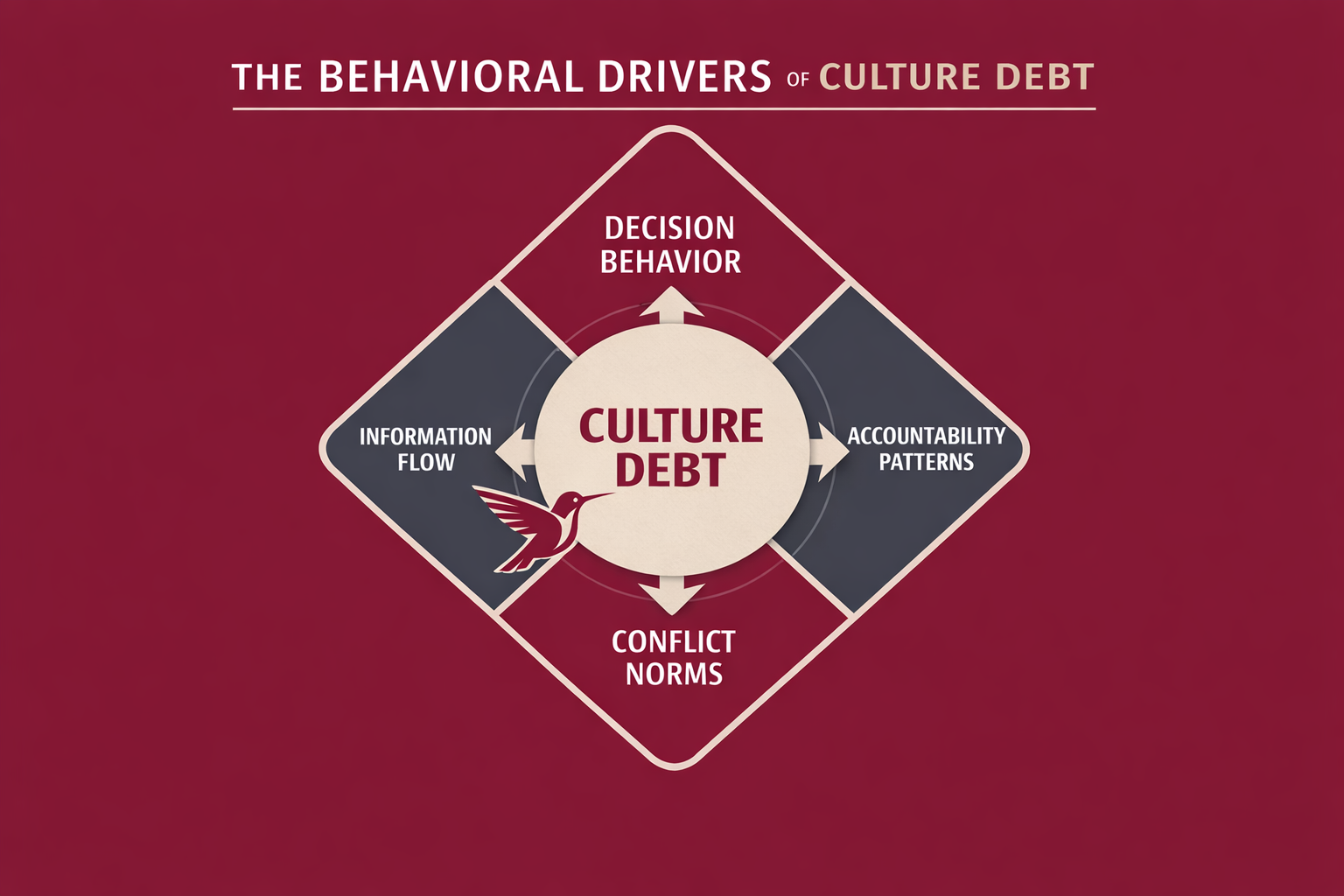
Every organization runs on behavioral patterns—how decisions are made, how information moves, how expectations are reinforced, and how tension is handled. These patterns form long before leaders formally label them as culture, and they shape how work gets done in ways that become visible only in hindsight.
Decision Behavior
Culture debt often first takes root in the way decisions are made.
When decision rights are unclear or inconsistently reinforced, teams learn to compensate. They escalate issues that don’t require escalation, delay action to avoid missteps, seek informal approvals, or reopen conversations that were supposedly settled.
Over time, this creates decision fatigue—and decision fatigue becomes a form of culture debt.
Information Flow
Culture debt also forms through the way information moves—or doesn’t move—across the organization. When access to context is uneven, people fill gaps with their own interpretations. Assumptions replace clarity. Alignment becomes fragile.
Communication becomes selective rather than systemic, and the organization begins to operate on multiple “versions of truth.”
Accountability Patterns
Inconsistent accountability is one of the fastest accelerants of culture debt.
When expectations are vague or enforced differently across leaders, people adjust to the inconsistency. Standards shift depending on who is involved. Predictability erodes. Trust thins quietly.
That adjustment—made silently and over time—becomes part of the culture itself.
Conflict Norms
Unspoken or avoided conflict is another driver that compounds culture debt.
When tension is not surfaced early, it does not disappear; it simply moves underground. Collaboration becomes polite but brittle. Misalignment grows in the background until it shapes performance outcomes.
Unaddressed tension becomes structural, reshaping how people interact and make decisions.
The Pattern Beneath the Pattern
Culture debt rarely begins with a dramatic failure.
It forms through small behaviors that repeat without examination—tiny moments of drift that accumulate until they shape how the organization functions.
Behavior → Pattern → Norm → Culture → Performance.
By the time performance declines, the underlying behavioral drivers have often been active for months, sometimes years.
The Leadership Implication
If culture is shaped by behavior, then alignment work must begin with behavior—not messaging, not motivation, and not restructuring.
Leaders who interrupt culture debt early focus on:
-
clarifying decision rights
-
stabilizing information flow
-
reinforcing accountability consistently
-
normalizing productive conflict
These interventions are precise, practical, and often far simpler than organizations expect—because they target the mechanisms that truly shape culture below the surface.
Looking Ahead
In the next article in this series, we will examine the four types of culture debt that organizations most commonly carry—and how to diagnose which one is operating inside your system.
Because culture debt is not abstract, it is behavioral. Behavior is changeable.