Seven weeks ago, my world narrowed.
Not intellectually. Not professionally.
Physically.
And in that narrowing, I began to see accessibility differently.
What I once understood conceptually, I now understand experientially.
Accessibility is not an accommodation.
It is not a courtesy.
It is not a symbol on a door.
It is design.
Accessibility Is Not an Assumption — Until It Has to Be
Before this injury, I would have said I understood accessibility.
Ramps. Elevators. Parking spaces.
The visible markers.
What I did not fully appreciate was the invisible layer:
-
How heavy doors feel when balance is compromised.
-
How narrow hallways become strategy sessions.
-
How exhausting “simple” outings can be.
-
How much cognitive energy goes into planning what once required no thought.
Accessibility is not about adding something extra.
It is about assuming someone in the room may be navigating differently.
That assumption changes how we build.
Accessibility Is Not a Checkbox
Let me say this plainly:
Much of what is labeled “accessible” is compliant — not usable.
Over the past seven weeks, I’ve stayed in hotel rooms and used public restrooms marked accessible.
On paper, they met the standard.
In reality?
-
The wheelchair cleared the doorway — barely.
-
The accessible stall required precision turns.
-
The sink placement assumed reach that didn’t match my balance.
-
The shower had grab bars — but the layout required contortion.
Technically compliant.
Practically constrained.
Compliance answers the question:
Did we meet the regulation?
Accessibility asks a different question:
Can a person move through this space with dignity and ease?
Those are not interchangeable questions.
Compliance satisfies the law. Design honors the person.
If a wheelchair barely fits, it communicates something subtle but powerful:
You were considered — but not centered.
Accessibility that forces someone to maneuver strategically just to function is not accessibility. It is accommodation by tolerance.
And tolerance is not excellence.
Independence Is Psychological
The hardest part of this season has not been pain.
It has been dependence.
For the first time in 43 years of marriage, my husband has become, in many ways, my handler.
He scans environments before I enter them.
He evaluates terrain.
He opens doors.
He repositions furniture.
He calculates incline, clearance, and stability without announcing that he’s doing it.
If a space is not accessible, he navigates it first — determining whether it can be made safe.
What 43 years teaches you is this: partnership evolves with circumstance.
We have adapted through seasons of career growth, parenthood, caregiving, and reinvention.
This is simply another adaptation.
But this season revealed something we had never needed to confront.
Even our home was not fully accessible.
Steps that once felt ordinary became barriers.
Thresholds became obstacles.
Door frames revealed their narrow margins.
So he built a ramp.
Not as a grand gesture.
As a necessity.
There is something profoundly humbling about realizing that independence is often invisible until it is interrupted.
Independence is not just physical capability.
It is psychological autonomy.
And when access depends on someone else’s vigilance or improvisation, it changes how you experience space.
In organizations, we do this too.
We rely on informal “handlers” — the colleague who smooths conflict, the leader who translates ambiguity, the employee who absorbs friction others never see.
But when access depends on a person rather than a system, it is fragile.
True accessibility does not rely on heroics. It relies on structure.
Energy Is a Currency
Every movement now costs something:
-
Standing
-
Turning
-
Reaching
-
Getting in and out of a car
-
Showering
Energy must be budgeted.
That reality reshaped how I think about workplaces.
How often do we design assuming unlimited capacity?
How often do we normalize unnecessary friction?
Accessibility is not only architectural.
It is operational.
The Equitable Excellence™ Lens
This experience has reinforced something central to my Equitable Excellence™ framework:
Excellence is not achieved when standards are applied uniformly.
It is achieved when systems are designed for variability.
Equity is not about lowering the bar.
It is about removing unnecessary friction so performance can rise.
When we design only for the average user, we force others to adapt.
When we design for the margins, everyone benefits.
Wider doorways benefit more than wheelchairs.
Clear pathways benefit more than mobility devices.
Thoughtful pacing benefits more than recovery journeys.
Equitable Excellence moves leaders beyond compliance and into intentional design.
It shifts the question from:
Is this allowed?
to
Is this navigable?
From
Does this meet the rule?
to
Does this preserve dignity and enable performance?
Accessibility, viewed through this lens, is not a special initiative.
It is operational intelligence.
Seven Weeks In — and Still Transitioning
My recovery is ongoing.
And it will not resolve quickly.
The progression from non-weight bearing…
to partial weight bearing…
to walking…
to eventually driving again…
is measured in months, not weeks.
Each phase is structured.
Each phase is guided by expertise — a physician, a surgeon, physical and occupational therapists.
Each phase is incremental.
Healing is deliberate.
And much of it is invisible.
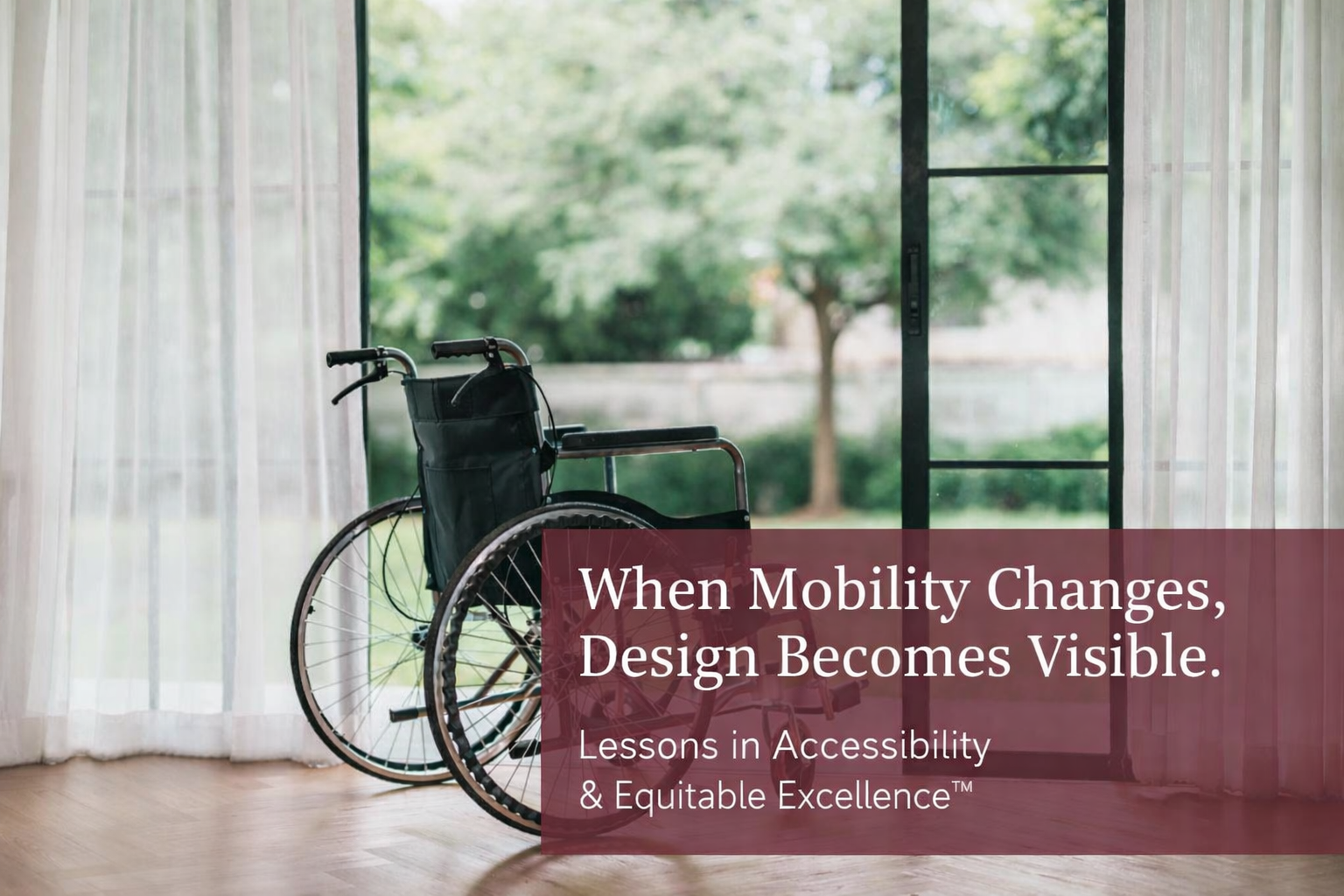
The clients I serve do not see the wheelchair just off camera.
They do not see the energy budgeting between meetings.
They do not see the recalibration required after a full day of facilitation.
What they see is presence.
Recovery, like organizational transformation, often happens beneath the surface.
Progress can be real long before it is visible.
As I transition through each stage, I am paying attention to what structured support makes possible.
Because no one regains capacity alone.
It takes expertise.
It takes systems.
It takes patience with the process.
And once you understand how long recovery can take — how many hands it requires, and how invisible the work often is — you lead differently.
Accessibility is not about sympathy.
It is about foresight.
As leaders, we have a choice.
We can design for compliance — or we can design for dignity.
The difference is not cosmetic.
It is operational.