In Articles I and II of the series, we established that culture debt forms through repeated, unresolved behaviors—and that those behaviors are shaped by how decisions are made, how information flows, how accountability is reinforced, and how conflict is handled.
But for many leaders, the question remains:
What does culture debt actually look like inside an organization?
Admittedly, it rarely announces itself clearly. It shows up as friction that feels familiar, patterns that feel persistent, and challenges that resist traditional solutions.
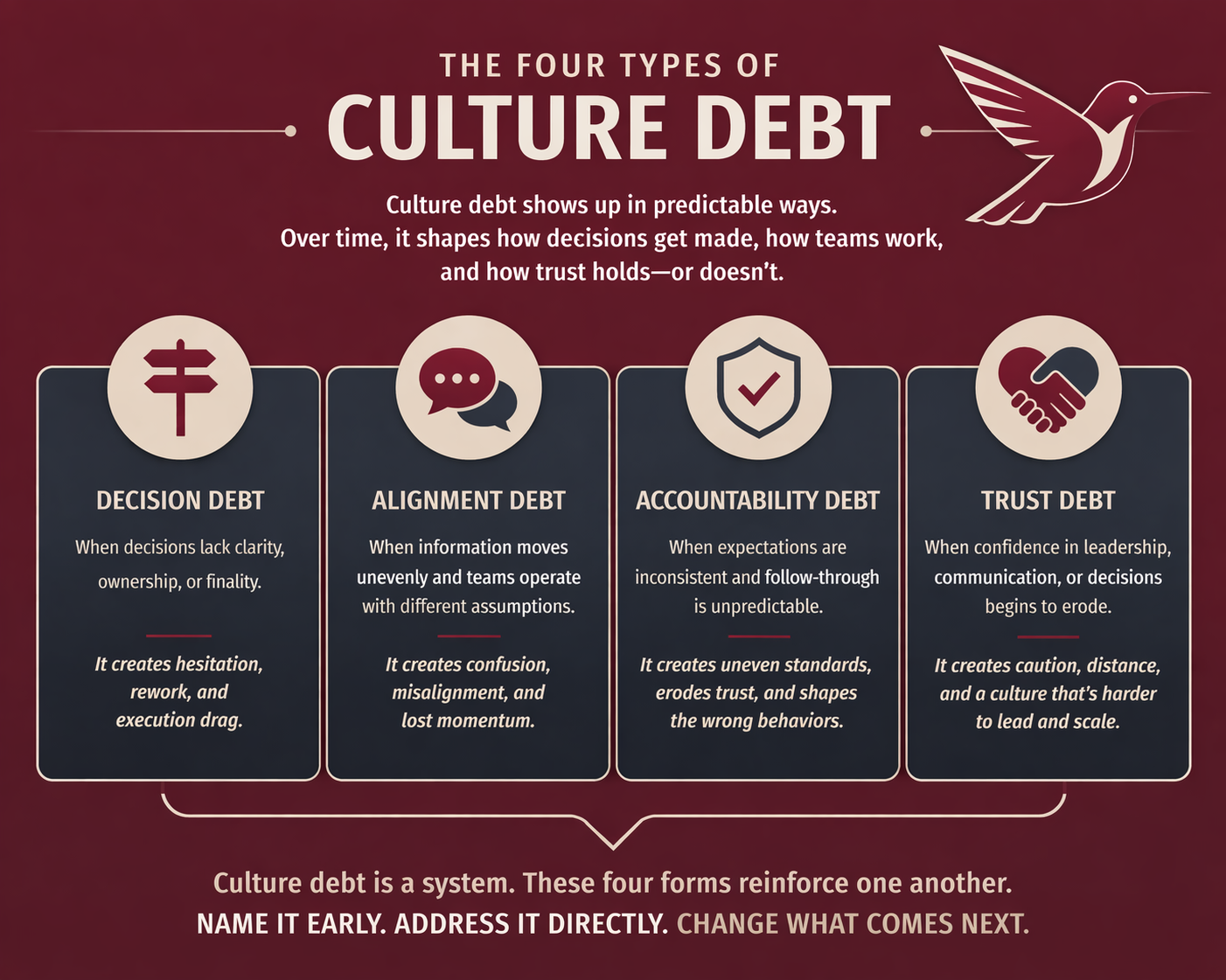
Over time, culture debt tends to take one of four recognizable forms.
This article provides a diagnostic lens for understanding how culture debt shows up inside organizations.
Decision Debt
Decision debt forms when clarity around decision-making begins to erode. Decisions are revisited, delayed, or quietly overridden. Ownership becomes ambiguous, and teams hesitate—not because they lack capability, but because they lack confidence in how decisions will hold.
What begins as inconsistency eventually becomes fatigue. And that fatigue slows execution in ways often misattributed to workload rather than to the structure of decision-making itself.
Alignment Debt
Alignment debt develops when information moves unevenly across the organization. Teams begin operating with different assumptions, priorities, or interpretations of strategy. Conversations feel aligned in the moment, but execution reveals divergence.
This is not a failure of intent. It is a failure of shared context.
Over time, the gap between intention and understanding creates a form of cultural drag that leaders can feel, but cannot always immediately explain.
Accountability Debt
Accountability debt emerges when expectations are inconsistently defined or reinforced. Standards vary depending on the situation, the leader, or the level of the organization. Follow-through becomes unpredictable.
People adapt quickly to this environment. They learn where accountability matters and where it does not. And in doing so, they reinforce the very inconsistency that created the issue.
Trust does not break loudly in these environments. It thins gradually, becoming less reliable with each exception.
Trust Debt
Trust debt forms when confidence in leadership, communication, or decision-making begins to erode beneath the surface. It is often the result of unresolved tension, avoided conversations, or patterns that feel misaligned but remain unaddressed.
Teams may continue to perform, but the underlying cohesion begins to weaken. Collaboration becomes more cautious. Feedback becomes more measured. And over time, the absence of trust reshapes how people engage with both their work and one another.
The System at Work
These forms of culture debt rarely exist in isolation. Decision debt can lead to alignment debt. Alignment debt can create accountability gaps. Accountability inconsistency can erode trust. And trust erosion can, in turn, influence how decisions are made.
What leaders often experience as a single issue is, in reality, a system of reinforcing patterns.
The Leadership Opportunity
Culture work cannot remain at the level of values or messaging. It must move into the realm of behavioral clarity and structural alignment.
The opportunity for leaders is not simply to recognize that culture debt exists, but to identify which form is most active within their organization—and to address it with precision.
Looking Ahead
In the next article in this series, we will explore how culture debt compounds over time—and where leaders can interrupt those patterns before they begin to shape performance.
Because culture debt is not static.
It builds, it spreads, and when left unaddressed, it reshapes performance in ways that are entirely predictable.